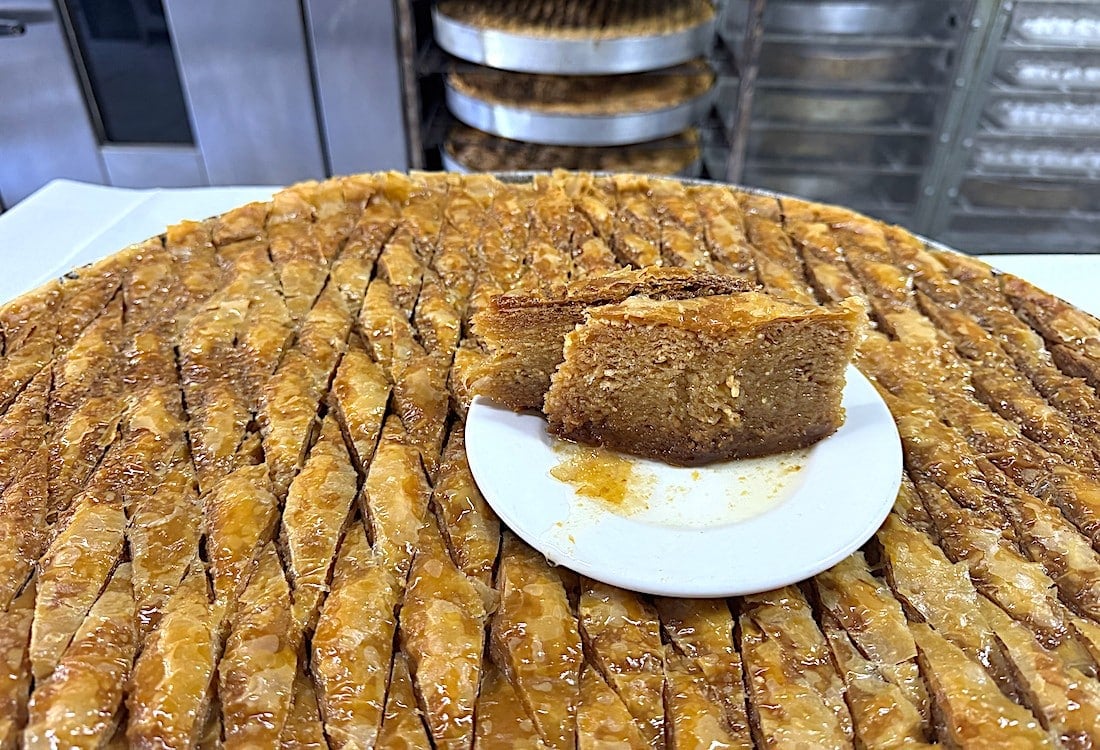
The history of the Baklava of Kymi, often called the Koumiotikos baklava, is a compelling narrative of local identity, economic survival, and a deep culinary tradition, rooted in the town of Kymi on the island of Evia.
The town’s historical commercial success and strong agricultural production created the perfect environment for refining this esteemed sweet.
Kymi Baklava: Roots in Byzantium and local refinement

Kymi’s baklava tradition intertwines with its history as a prominent trading hub. According to baklava specialist Voula Sideraki, the basic sweet evolved from earlier times:
“Baklavas, since we had a variety of almonds, walnuts and honey, was the sweet, the basic, of the style we know until the Byzantine period. We do not know anymore what sweets they had and what products. So, Baklavas, in Byzantium, where the ancient Kumiotes merchants got ideas from the royal palaces, from the then king, emperor and Englishmen over there, their custom was the Eastern sweets, anyway.”
However, the people of Kymi sought to elevate the sweet, combining it with their community’s prosperity and celebrations:
“But we wanted to make our Baklava a little better, a little more impressive, since we always had prosperity and a good life, and we wanted to combine Baklava with the happiness of the wedding, of the celebrations. It was a sweet that we would win and it had an importance for us,” Sideraki who owns a bakery specializing in baklava in Kymi, told Greek Reporter.

Defining characteristics: 100 sheets and unique ingredients
The Koumiotikos baklava stands apart due to specific adaptations that are now tied to ritual and symbolism, particularly the shape and the sheet count.
The famous thinness of the dough became a measure of skill, while the shape acquired an imperial meaning:
“We changed the shape and instead of squares we made rhombuses, which are a little richer, more imperial, anyway. It has a great reputation as a sweet. Back then, the old royal houses had Baklavas inside and they were kept for a long time, but we made it mainly for holidays that meant something to them,” Sideraki says.
The 100 layers (“the leaf eats the almond, the leaf eats the almond”) are not just for texture; they carry a beautiful symbolic meaning for celebrations:
“The 100 leaves symbolize the 100 years of happiness, prosperity. As we say, to be blessed when you have a wedding, this means the 100 Baklavas, to have happiness, prosperity, 100 years of health, and all that.”

The authentic flavor of Kymi Baklava is defined by its filling choice (almond or walnut) and its use of unique fats and syrup. Unlike versions using oil, Kymi’s uses fresh dairy fat.
“The difference with the other sweets in Greece, the Baklavas, is that we use pure sheep’s milk, because we had goats and sheep back then, so we used what we could get, but it also gave it a special taste compared to the oil Baklavas,” SIderaki told Greek Reporter.
“We also used honey syrup, it’s not just sugar syrup, it has honey in it. This makes it even tastier.”
Kymi’s baklavas and the engagement ritual

The baklava played a special role in the customs surrounding marriage proposals.
“In any case, when the groom went to ask for the bride, his mother would make him a plate, very nice, with Baklavas, rhombuses, decorated and sweet, as if it were a big star. And she would make it very nice, with flowers. It was very sweet.”
Kymi’s commercial fleet, which exported kokkineli (must) and propelled the town’s prosperity until the 1930s, also facilitated the cultural exchange that brought the baklava recipe home.

This sweet later became a critical export product and an economic lifeline during periods of emigration, especially in the late 19th and early 20th centuries.
Today, the Kymi Baklava (PDO status) remains a protected designation, ensuring that this ritualistic, delicately structured sweet continues to honor the tradition and prosperity of its hometown.
Related: Baklava: The Dessert That Has Greeks and Turks Fighting Over Its Origin