A radical map that emerged from British planning circles during the lead-up to the Tehran Conference in late 1943 shows that British PM Winston Churchill entertained the idea that Greece should take control of southern Italy (Magna Graecia) as part of a highly controversial and ultimately rejected plan to dismember the Italian peninsula.
While the Tehran Conference is remembered for the crucial decisions regarding the opening of the Second Front during WWII, the map continues to fuel historical debate.
This purported document, which outlines a complete dismemberment of Italy into distinct zones of Allied influence and annexation, is widely considered an extreme proposal that never advanced beyond internal discussion.
The map, which is difficult to trace to a definitive, publicly cited British primary source, illustrates a shocking vision for the post-war Italian peninsula:
The Northwest ceded to France. The Northeast was to be annexed by Yugoslavia, and central Italy was to become an Anglo-American sphere.
The Audacious Claim: Greece and “Magna Graecia”

Perhaps the most culturally and historically resonant element of the concept map is the proposal that Greece be given control over Italy’s deep south, a territory referenced historically as “Magna Graecia” (Greater Greece). This included large swathes of Calabria and Puglia, regions heavily colonized by ancient Greeks.
Italian historical commentary frequently discusses the map as the “proposta inglese di smembramento dell’Italia” (the English proposal for the dismemberment of Italy) from Tehran.
Historians view this particular detail as a strong reflection of Winston Churchill’s strategic priorities. Churchill was a passionate advocate for securing the Mediterranean and was deeply concerned with stabilizing post-war Greece, which was under Nazi occupation at the time. The concept of transferring territory to an ally like Greece may have been considered a way to:
- Reward Allied loyalty and resistance.
- Create a strong, pro-Western bulwark in the Eastern Mediterranean.
- Secure British influence in the region by bolstering an ally.
The Reality: A Plan Scrapped by the “Big Three”
Despite the ambitious nature of the concept, historians are clear that this specific plan for territorial dismemberment was never implemented and was quickly rejected.
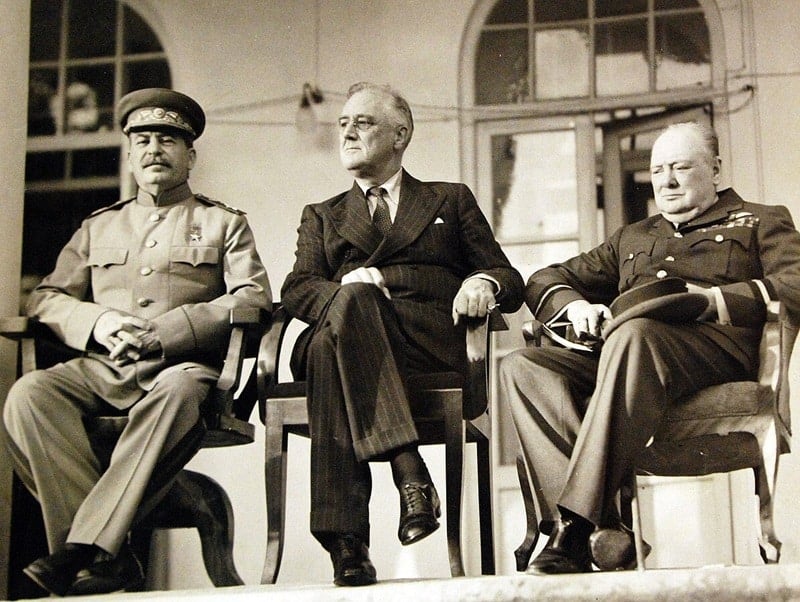
Both U.S. President Franklin D. Roosevelt and Soviet Premier Joseph Stalin opposed such a drastic partition, opting instead for a unified Italy under the initial Allied Military Government (AMGOT).
The radical nature of the divisions, combined with the lack of its direct inclusion in final, public-facing Tehran protocols, leads many to classify the map as an extreme internal concept document or a geopolitical “what if” scenario generated by mid-level planners, rather than a formal, ratified proposal from Churchill himself.
The document, therefore, serves not as a factual historical agreement but as a compelling illustration of the sheer scale of the geopolitical reordering that was contemplated, and ultimately dismissed, by the Allies during the most critical phases of World War II.
Related: When Churchill and Stalin Decided Greece’s Fate on a Scrap of Paper