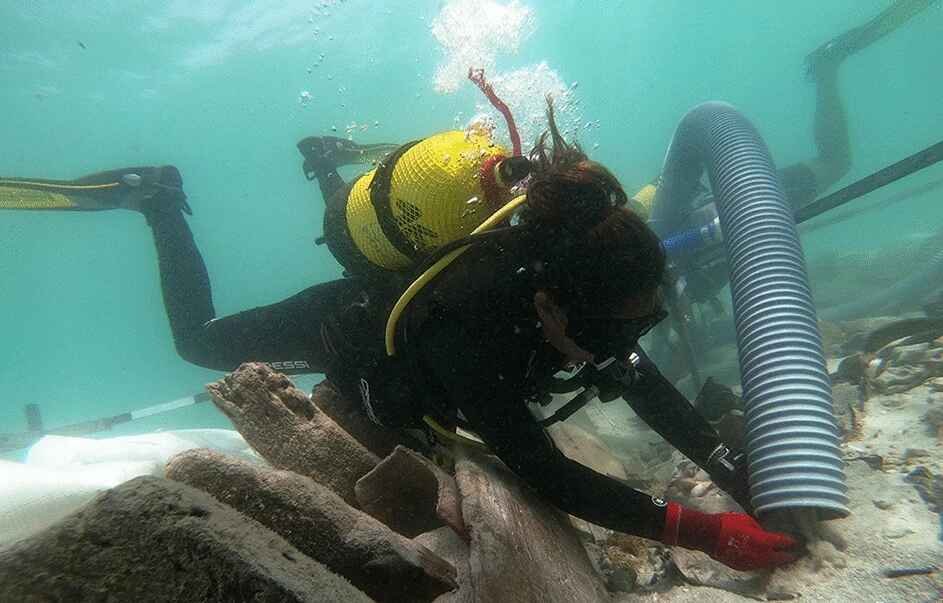

Mallorca’s popular Playa de Palma has revealed an unexpected chapter of history. Just two meters (6.5 feet) below the beach, archaeologists confirmed the presence of an ancient Roman shipwreck found off Mallorca, almost fully preserved after 1,700 years under the sand. The 4th-century merchant vessel still holds more than 300 amphorae packed with oil, wine and garum, the fermented fish sauce once regarded as a luxury staple in Roman cooking.
The wreck, named Ses Fontanelles shipwreck, was first spotted in 2019 when local diver Félix Alarcón noticed fragments of wood exposed after a storm. His alert set off a large-scale research effort now led by the Arqueomallornauta project with support from the Consell de Mallorca. The team plans to raise the ship in 2026 in what researchers describe as a landmark case for European underwater heritage.
Archaeologists from the universities of Barcelona, Cádiz, Valencia and the Balearic Islands confirmed the vessel measures about 12 meters (39 feet) long and up to 6 meters (20 feet) wide. It survived in exceptional condition because the hull was buried in sand, creating an oxygen-free layer that slowed decay.
A coin found beneath the mast allowed experts to date the sinking to around 320 AD. The coin was minted in Siscia, now part of Croatia, and its location reflects a Roman tradition of placing a coin under the mast for good fortune.
Significance of the ancient Roman shipwreck found off Mallorca
Scientific analysis of the cargo shows the ship sailed from Carthago Spartaria, present-day Cartagena, one of the most active ports in Roman Hispania. Many amphorae remain sealed, with some still holding organic traces of premium garum known as liquaminis flos, made mostly from anchovies.

Others contain olive oil, wine or fermented must used to preserve fruit. Painted labels on many jars list the product, origin, producer and taxes, a type of inscription experts call titulus pictus. Researchers say this collection is among the most complete ever recovered.
Several personal belongings were also found, including an oil lamp featuring the goddess Diana, two shoes made of leather and esparto grass, ropes, plant remains and a bow drill used for repairs. Although the hull is largely intact, later studies confirmed the keel is missing, which means the ship will be removed in sections.
Artifacts and long-term conservation plan
The National Museum of Underwater Archaeology has joined the project and will supervise the extraction.
The operation, presented at a maritime archaeology conference in Palma, is expected to take at least five years. Once raised, the wooden structure will be transferred to San Carlos Castle for desalination and conservation.
Researchers say the ancient Roman shipwreck found off Mallorca offers a rare look at daily trade during a period of political and religious change in the empire, including evidence of Christian symbols on some cargo seals.
They describe the site as a once-in-a-generation discovery that will reshape knowledge of late Roman commerce in the western Mediterranean.