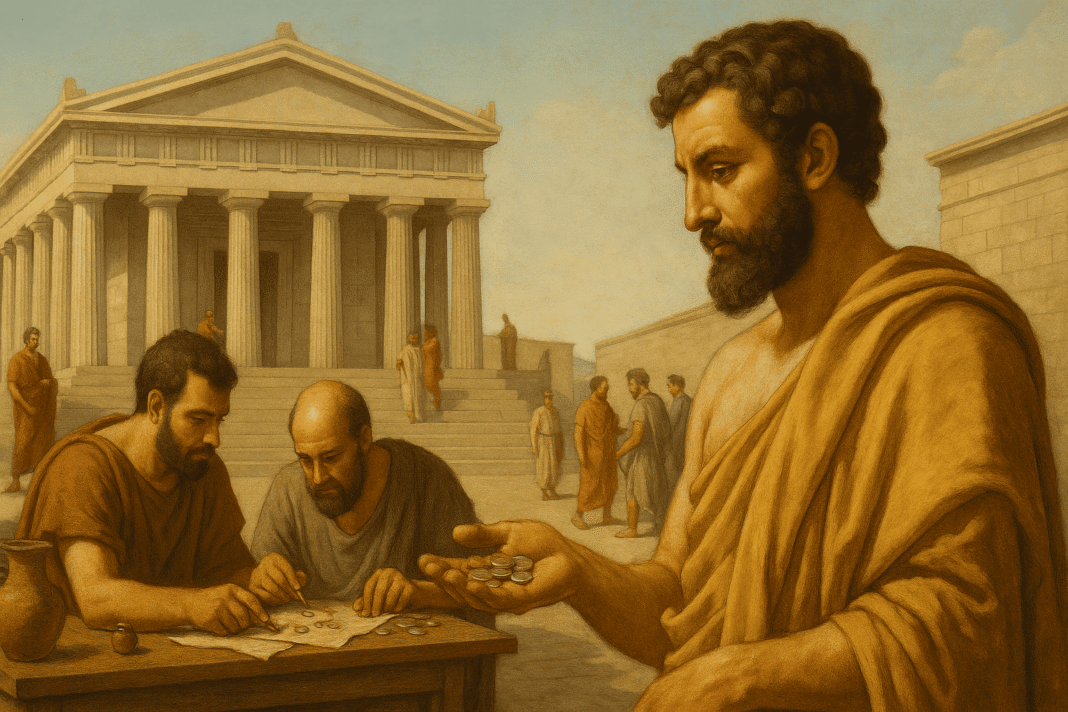

The enduring influence of Greek art and philosophy in modern times was explored during a thought-provoking discussion on Wednesday at the Liszt Institute, examining why the legacy of Ancient Greece—long celebrated as the cradle of Western civilization and a source of democratic and artistic innovation—is increasingly scrutinized as Eurocentric or tied to white supremacy.
The event, titled “Who’s Afraid of the Ancient Greeks?”, was hosted by the Mathias Corvinus Collegium (MCC) Brussels at the Liszt Institute. Scholars from philosophy, history, and the arts gathered to discuss whether Greek thought still matters—or whether it has become a relic of the past.
Europe’s view of Ancient Greece: Looking back to move forward

Speakers agreed that Ancient Greece remains the starting point of Europe’s political and cultural imagination. They recalled historic moments like the Battle of Salamis, when Athenian sailors defeated the Persians, an event that gave ordinary people the confidence to demand a voice in democracy. Historians such as Paul Cartledge have noted that the very rowers who risked their lives at sea later demanded political rights, transforming courage at sea into equality on land.
Professor Frank Füredi, Executive Director of MCC Brussels, said forgetting such moments risks turning democracy into an empty ritual rather than a lived practice.
A case for cultural confidence
Philosopher Benedict Beckeld, author of “Western Self-Contempt: Oikophobia in the Decline of Civilizations,” argued that Europe’s growing discomfort with its own traditions weakens its ability to renew itself. He compared cultural confidence to personal integrity—without pride in one’s origins, renewal becomes impossible.
Beckeld added that valuing one’s heritage does not mean rejecting others; it means recognizing the sources of one’s moral and political vocabulary. Classicist Edith Hall has made a similar point, writing that Athenian democracy depended on citizens who were expected to argue in public rather than apologize for doing so— a discipline modern Europe risks losing.
Reason and moderation as Greek lessons
Historian Alexander Meert described Greek philosophy as a lifelong practice of balance. The Ancient Greeks, he said, joined reason with wonder and believed that learning came through open debate. He cited the debate between phýsis and nómos—nature and law—as the foundation of political thought, and Plato’s story of the Ring of Gyges, which asks whether people would still act justly if unseen.
These questions, Meert noted, still anchor courses in ethics and political philosophy from Oxford to Harvard. He warned that when universities hide difficult material behind “trigger warnings,” they abandon the Greek lesson of endurance before truth. Education should make students resilient, not fragile.
What art can still teach
Film scholar Maren Thom turned the conversation to drama. She said Greek tragedy was a form of civic education rather than entertainment. Aristotle’s Poetics described tragedy as catharsis, a purging of fear and pity that built moral strength. Athens even funded the poor through state grants called theōriká so everyone could attend the theater.

Thom echoed philosopher Martha Nussbaum, who argues that tragedy trained citizens to face emotion responsibly rather than avoid it. She warned that modern storytelling often removes discomfort, “sanitizing” art until it loses power.
Reading the past without distorting it: Ideals of Ancient Greece and their place in Europe today
Speakers also warned against applying modern categories to the ancient world. They noted that the Greeks had no single word for “religion”; their gods were woven into festivals, laws, and daily rituals. The adjective átheos (atheist) originally meant “forsaken by the gods” before later coming to mean disbelief—proof that meanings evolve and require care.
To us, Ancient Greece is a distant culture of mystery and intrigue.
But the Greeks also lived in the ruins of a civilization they couldn’t understand — or build themselves.
What Homer wrote about them will transform your understanding of history… (thread) 🧵 pic.twitter.com/cBMCcMBNg0
— The Culturist (@the_culturist_) November 14, 2024
The debate closed with a shared view: Greek civilization is not a museum piece but a workshop of renewal. It reminds Europe that freedom, art, and inquiry demand participation rather than reverence.
As one speaker summarized, reconnecting with Greece is not nostalgia. It is practice. The courage to argue, the patience to listen, and the will to endure are still Europe’s greatest inventions.


