
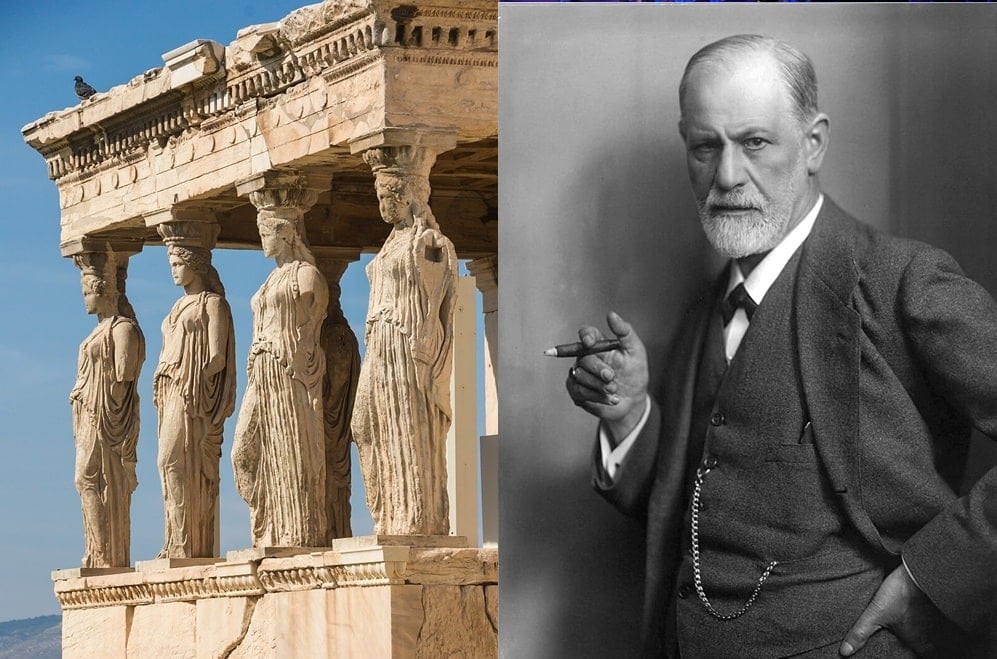
Sigmund Freud, the Austrian neurologist and the founder of psychoanalysis, had only one experience at the Acropolis in Athens, but it seems to have been an intense one.
He was an older man in 1904 and was accompanied by his younger brother, Alexander. As was fashionable for high society of the time, Athens was an obligatory stop in the Grand Tour, and this was no exception for the Viennese brothers. However, they had their travel plans to Corfu disrupted, and they stopped in Athens a while longer than planned.
In his letters, Freud mentions that the first feeling was one of deja vu. Indeed, he had seen a replica at the Volksgarten in Vienna, where an exact copy had been commissioned by Napoleon.
He wrote to his wife that it “surpasses everything that we’ve ever seen and that one can imagine” and that the view from the citadel was “herrlich” (“splendid”).
That was not all. On the Acropolis, Freud experienced something like a “disturbance of memory” (Erinnerungsstörung). It was something he would later identify and analyze. He spent a long time contemplating this experience and wrote about it years later in a letter to Romain Rolland, a French author and Freud’s friend.
“A Disturbance of Memory on the Acropolis” is now considered a seminal work. He considered self-analysis to be just as important, and later expanded on this term, analyzing what he considered to be the structure of derealization.
Sigmund Freud: “I am now standing on the Acropolis, only I don’t believe it.”
“By the evidence of my senses, I am now standing on the Acropolis, only I don’t believe it.”
Greek history and mythology had deeply inspired the Viennese psychologist since childhood, as is evident in his psychoanalytic work. He was puzzled about the detachment he experienced there and considered it to be a defense mechanism. The question, however, is from what. Was derealization a defense from dreams coming true?
The answer he came to was, strangely enough, Oedipal. He wrote:
“To this general motive [i.e. of guilt, that the son should surpass the father] is added the particular factor that in the theme itself of Athens and the Acropolis there is contained an indication of the sons’ superiority [Uberlegenheit]. Our father had been a businessman [Kaufmann], he possessed no Gymnasium education, Athens could not mean much to him. What disturbed us in our enjoyment of the trip to Athens was therefore a feeling of [filial] piety.”
It was not only a collision of emotions that came over the visitor, but much more than that. Freud must have felt transformed by the primeval symbolism of the Acropolis in extreme contrast with the author’s German identity, his classical education, and modernism. The trope of the destroyed temple in Judaism must have indeed struck some emotional chord in the author of the letters.
If Freud had been a Romantic artist rather than a modern-day poet, he might have seen it in a very similar way to Stendhal upon his visit to Italy, where he experienced similar feelings and attributed this uniquely to the beauty he was experiencing. This would later be termed Stendhal’s syndrome.
The problem of extreme beauty and harmony causing at least some distress in humans might or might not be anything new. Some have talked about this, while others have only described extreme peace and happiness.
The only certainty is that beauty helps humans conceive of their finiteness in the face of such ancient wonders. Protecting monuments for future generations so that they, too, may wonder at the depths of human experience is an essential duty of humanity.
Freud and ancient Greece
Freud saw a strong parallel between the work of an archaeologist and that of a psychoanalyst. Just as an archaeologist unearths hidden layers of an ancient city, a psychoanalyst uncovers repressed memories and unconscious thoughts from a patient’s past.
This metaphor, which he used in his writings, draws from the archaeological discoveries happening in Greece and Italy during his lifetime, which captured the public’s imagination.
Freud had a strong classical education and was a lifelong collector of antiquities, including Greek and Roman artifacts.
His use of Greek concepts and figures wasn’t accidental; it was part of a larger intellectual tradition that saw ancient Greece as a key to understanding human nature and Western civilization. He used these references to lend authority and a sense of timelessness to his new field of psychoanalysis.
Freud used the myth of Oedipus, the king who unknowingly kills his father and marries his mother, as the foundation for his theory of the Oedipus complex. He believed this to be a universal stage of psychosexual development in which a young boy harbors unconscious desires for his mother and feelings of rivalry toward his father.
This concept, central to his psychoanalytic theory, is directly named after a Greek mythological figure. Similarly, the Electra complex, a parallel theory for girls, is named after another Greek myth.


