Ever wondered what a Spartan warrior looked like, what he ate and what diseases he was prone to develop? Or what food intolerances did a city dweller of ancient Macedonia have during the Hellenistic period? Questions that may sound almost unanswerable thousands of years after these people lived, can now be solved thanks to a groundbreaking project that analyzes humans who lived in ancient Greece. Based on their skeletal remains and the reconstruction of each individual’s visible and functional phenotype, their biographies are created and then taken to museums and exhibitions to publicly unveil the unlocked, living secrets of Greece’s old-age inhabitants.
The European project, called BioMuse, is a collaboration between the Laboratory of Physical Anthropology of the Democritus University of Thrace, Greece, the Palaeogenetics Group of the University of Mainz, the Reiss-Engelhorn Museums Mannheim, both in Germany, and TETRAGON. The results relating to Greece’s genetic heritage have been presented in several exhibitions across Greece. Currently the biographies of ten men and women who lived at different times and in different parts of ancient Greece are presented at the Archaeological Museum of Drama until April 7, 2025. There, the public can delve into their daily lives, habits and way of life through a unique presentation.
“In reality, what we did was study the bones of these people so we can compose their stories, based on their age, sex and what they ate,” Prof. Christina Papageorgopoulou, head of the project and director of the Laboratory of Physical Anthropology at Thrace University tells AMNA.
Prof. Papageorgopoulou notes that the artifacts found in their graves added valuable information on building their biographies and that at the exhibition visitors can see not only what these individuals looked like and how they lived, but also get information “on their illnesses, the injuries they had, the likelihood of genetic diseases, their movement but also their food intolerances.”

The biographies behind the ancient bone fragments unearthed across Greece
The project aims to analyze a series of 50 humans, including their full genomes, who lived in Greece from the Mesolithic to the Byzantine period.
Currently, 10 of them are introducing themselves to the exhibition visitors through the characteristics of their bones: the hunter-gatherer of Astypalea, a 4-year-old girl called the memory keeper, the mother from Agios Panteleimonas in Florina, northwestern Greece, the Lacedaemonian of Sparta, the woman with the trepanned skull from Abdera in northeastern Greece, the history observer from Tenea, the city dweller from Thessaloniki and the warrior from Doliani.
The woman from Abdera with the trepanned skull, who lived in the Archaic period between 650-600 BC, is one of the most interesting cases because she underwent the ancient medical procedure of trepanation, a technique performed mostly in males, principally as a surgical treatment of cranial injuries and which is explicitly described by Hippocrates.
“From the analysis that we did, it appears that this woman had a predisposition for narcolepsy [a chronic neurological disorder],” Prof. Papageorgopoulou explains. “It is very possible that she suffered from this disease because she underwent the operation three times and she survived all three. We understand this from the degree to which the skull has healed each time.”
Moreover, according to BioMuse, the woman was between 45 and 51 years old, was lactose-intolerant, had pale skin and brown eyes.
The Lacedaemonian of Sparta on the other hand, had blue eyes and brown/blonde hair, he performed well at sports such as running and weight-lifting, 90 percent of his diet was animal and meat products, and he had a high likelihood of suffering a stroke and type II diabetes.
“At the lab, we study skeletal remains from many places where there are excavations,” Prof. Papageorgopoulou says, “but most of the material that we have been studying in the past few years comes from Thessaloniki, where excavations have been taking place for the operation of the metro. We have studied skeletal material from other ephorates too. The selection of the individuals was not random but based on specific data. They must all have those skeletal parts that can provide diagnostics for the elements we want to examine, to be from different parts of Greece, from different chronological times and their graves must have some burial findings.”
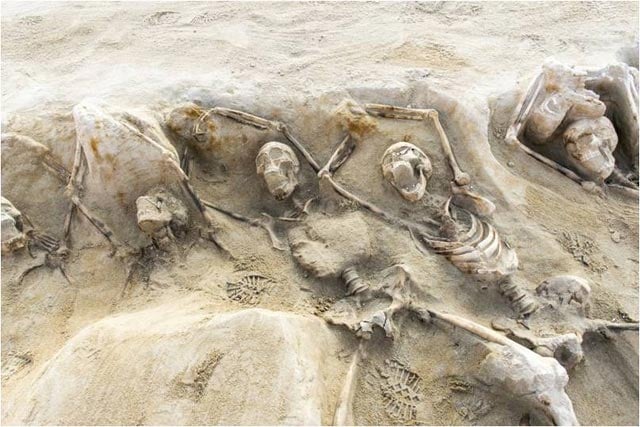
The unique evidence of the life of people in ancient Greece
The excavation, storage and study of bones is defined by scientific rules and a code of conduct. Their analysis is done in specialized laboratories and, as with every science, specific scientific protocols are followed. The composition of an osteobiography, which involves assembling all information available from the skeleton to create a life narrative for a single individual, is the result of a collaboration between many different individuals. Archaeologists, anthropologists and geneticists study and analyze the available data while museologists, architects and graphic designers recompose and highlight the ancient biographies.
In discovering the genetic history of those who lived in ancient Greece, scientists involved in the project also study their full genomes, meaning the complete set of information in the DNA of an organism. Today it is possible to study ancient DNA recovered from dead organisms (skeletons, mummies etc) found in archaeological excavations.