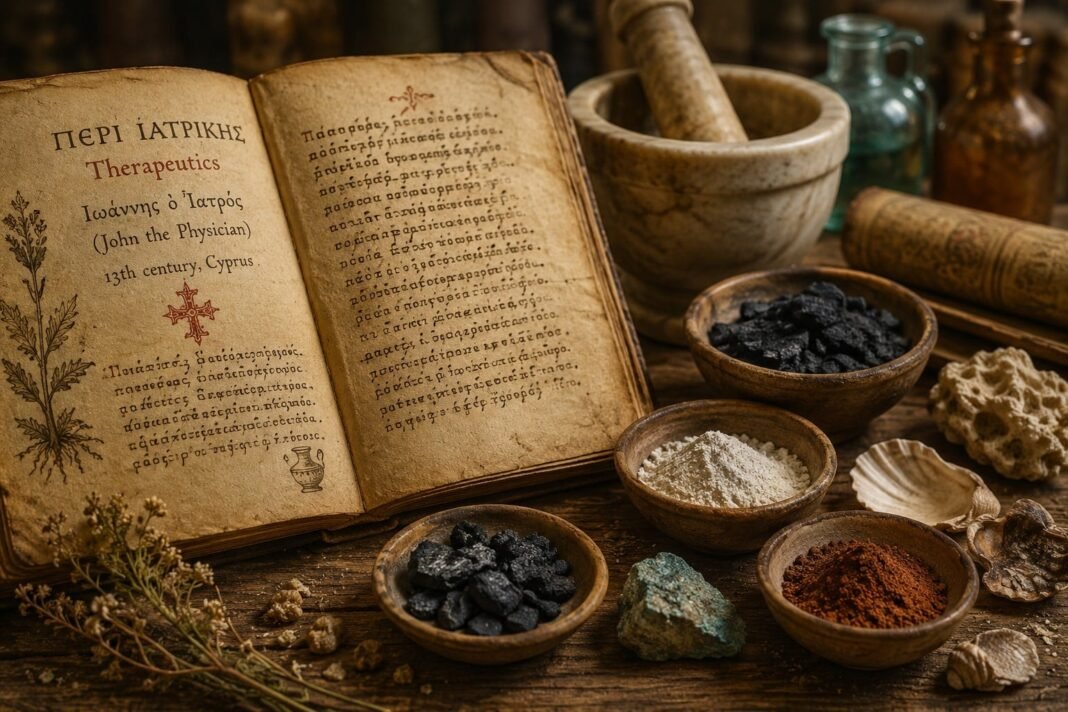

A 700-year-old medical text from Cyprus is giving researchers a rare look at ancient Greek medicine and the practical ways physicians prepared treatments for ordinary patients. The study suggests that some recipes used by a Byzantine Greek doctor may have had real medicinal value, even if they were based on limited resources and older medical traditions.
The research, led by Andrew C. Scott and published in Proceedings of the Geologists’ Association, examined the medical recipes of John the Physician. His work, known as Therapeutics, dates to the late 13th century. Researchers believe it was written in Cyprus.
A doctor writing for ordinary people
The text stands out because it was not aimed only at scholars. It appears to reflect everyday medical practice. John wrote in a local Greek dialect rather than formal ancient Greek. That choice suggests he wanted to reach people who could read but did not have advanced education.
Researchers say John was likely both a physician and a pharmacist. He seems to have treated patients with limited means. His recipes relied on ingredients that could be gathered or made locally, including plants, minerals, shells, animal parts and burnt materials.
The study focused on a difficult question: What were these ingredients, and why were they used?
Ancient names pose a modern problem
Ancient medical texts often name plants and minerals in ways that are hard to match with modern science. The same word could refer to more than one substance. A mineral name in an old text may not mean the same mineral today.
To solve this problem, researchers compared John’s text with earlier medical writings, especially De Materia Medica by the first-century Greek physician Pedanius Dioscorides. That work shaped medical practice across the Greek and Byzantine worlds for centuries.
A 700-year-old medical text from Cyprus is revealing how ancient Greek medicine was made in practice.
Researchers found that John the Physician used plants, minerals, shells, animal parts and fire to prepare treatments for ordinary patients. pic.twitter.com/kV473gKeCj
— Tom Marvolo Riddle (@tom_riddle2025) June 29, 2026
The team also studied the geology of Cyprus. That mattered because many of John’s ingredients may have come from the island itself. Cyprus was rich in copper and iron minerals. It also had salts, clays, limestone, gypsum and other materials that could be used in simple medical preparations.
Fire changed the ingredients
Researchers then reconstructed some recipes in the laboratory. They burned or charred materials such as cuttlefish bone, mussel shells, eggshells, deer horn, sponge, date stones, olive stones, cypress leaves and ivy roots. They tested how these materials changed with heat and how they reacted with water, wine and wine vinegar.
The results showed that burning was not always symbolic or accidental. In some cases, heat changed the structure of the material in useful ways. Burnt date and olive stones became porous, much like a simple form of charcoal. Such material may have helped absorb fluids or remove unwanted substances.
Other recipes used shells and bones. These materials contain calcium compounds. When burned and mixed with liquids such as vinegar, they released elements that may have affected wounds, teeth, or skin. Burnt sponge also released iodine, an element known for its role in health and wound treatment.
Some treatments carried risks
One recipe called for burned cuttlefish bone mixed with honey for an eye condition. Researchers said the treatment could have been risky if rough particles entered the eye. But they also noted that honey has antibacterial properties. The mixture may have been intended to gently treat surface problems on the eye.
The study does not claim that all the treatments were safe or effective. Some ingredients, including lead, arsenic and mercury, are now known to be toxic. But researchers found that several recipes followed a clear logic. They used local materials, simple processing and liquids that could draw out active elements.
A practical system, not random folk medicine
The findings show that John’s medicine was not random folk practice. It was a practical system shaped by older Greek medical knowledge, local geology and hands-on experience.
Researchers say the work also offers a new method for studying ancient pharmacy. By combining philology, geology, chemistry and experiments, they can better identify old ingredients and understand how ancient treatments may have worked.
The study suggests that a modest medical text from medieval Cyprus can still speak to modern science. It shows how one physician turned shells, stones, plants and fire into medicine for the patients around him.