

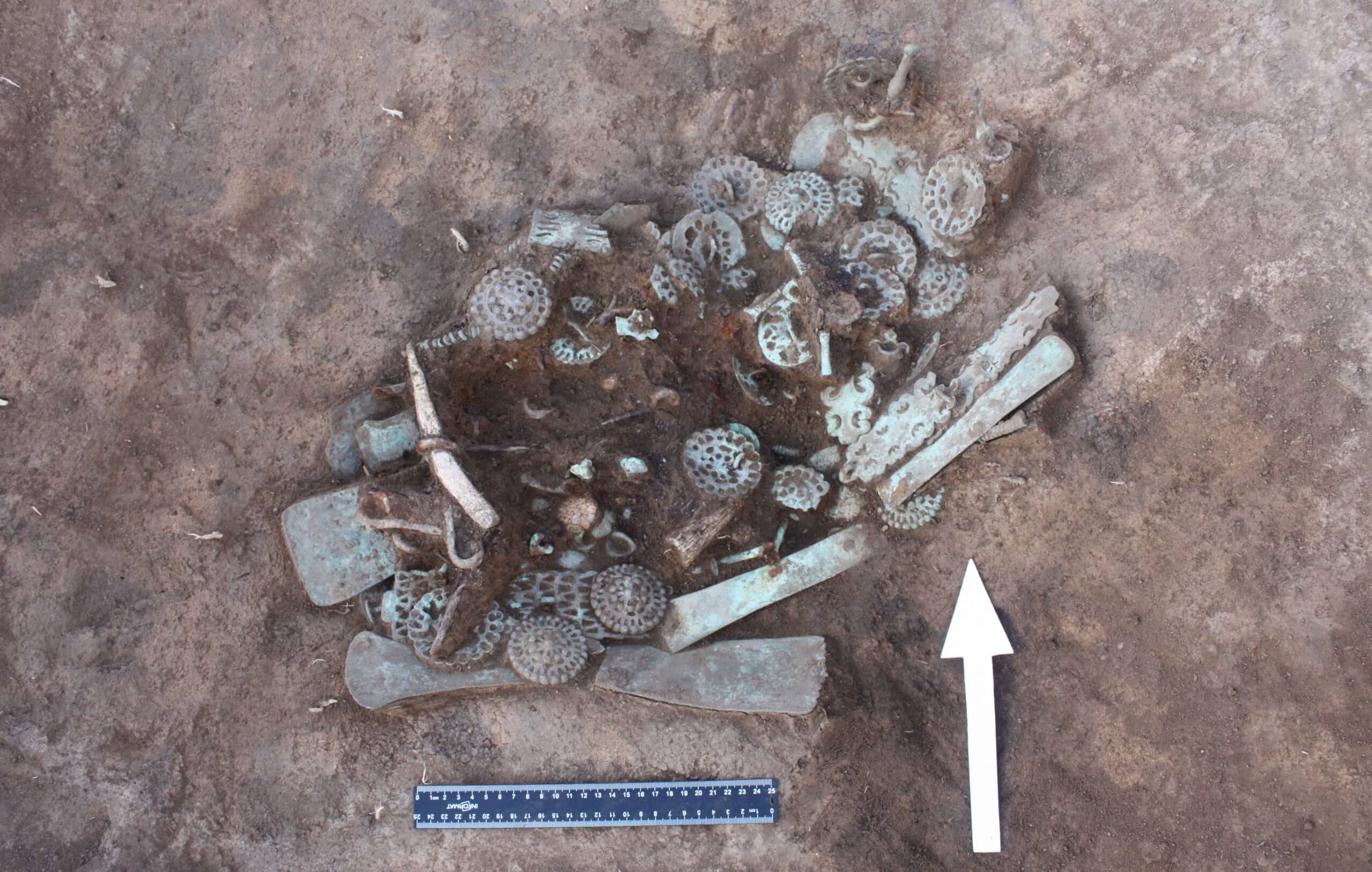
A remarkable sacrificial complex has been uncovered at an ancient necropolis in Russia, revealing how nomadic elites conducted rituals in the Southern Urals over 2,300 years ago. The team from the Institute of Archaeology at the Russian Academy of Sciences identified the find at the Vysokaya Mogila–Studenikin Mar necropolis in the Orenburg Region.
The deposit includes more than one hundred bronze objects, gold ornaments, and elite horse gear. Researchers say it is the richest ritual assemblage ever recorded in the inter-mound spaces of early nomadic necropolises in this part of the Eurasian steppe.
Excavations carried out across a vast burial landscape
The excavations took place in the summer of 2025 during the Ural Archaeological Expedition directed by D. S. Bogachuk and S. V. Sirotin. The burial ground stretches more than six kilometers (about 4 miles) across open steppe and contains five groups of burial mounds arranged in an irregular latitudinal chain.
Sacrificial complex uncovered in Orenburg pic.twitter.com/0djN3e2BUz
— Tom Marvolo Riddle (@tom_riddle2025) December 2, 2025
Early finds appeared around Kurgan 1 of the Vysokaya Mogila group, a monumental mound measuring 140 meters (460 feet) across and over 7 meters (23 feet) high. Scattered iron bridle bits and decorative fragments in plowed soil signaled the presence of ritual deposits that had been disturbed by farming.
Bronze frontlets and decorated plaques dominate the assemblage
Among the most striking artifacts were 15 to 17 bronze plate-style horse frontlets, found both intact and in fragments, and 30 openwork bronze plaques. A group of flat circular plaques with central protrusions drew particular attention.

Archaeologists documented twelve of these pieces, decorated with dotted motifs and imagery of swastikas, birds, and fantastical creatures. Small bridle plaques with diamond-shaped shields and additional harness fittings executed in the animal style added to the picture of high-status ceremonial horse equipment.
Unique ritual pieces reveal complex ceremonial behavior
Researchers also uncovered several unique objects not previously seen in the region, including bronze strap distributors shaped as plaques with human-like faces and a distinctive bronze pendant.

The ritual complex contained a wooden bowl with silver overlays in the animal style, the jawbones of a wild boar placed as a sacrificial offering, and fragments of a hand-molded ceramic vessel. These finds point to deliberate ceremonial actions carried out during the creation of the deposit.
Connections link the Southern Urals to wider cultural networks
Some items resemble artifacts known from wealthy Southern Ural contexts of the 4th to early 3rd centuries BC, such as iron and bimetallic psalia and certain types of openwork plaques. However, many pieces are entirely new for the region.
Openwork pierced frontlets, circular plaques with raised centers, and several forms of harness decorations have parallels in the North Caucasus, the Don region, and the Northern Black Sea area. These connections show how far-reaching cultural and artistic exchanges shaped the ritual world of Iron Age nomads.
Rare tiger motif underscores long-distance artistic influence

One of the most significant objects is a gold plaque showing a tiger’s head and foreleg. Tiger imagery is rare in the Southern Urals and suggests long-distance import or influence from eastern artistic traditions.
The ritual complex dates to a period of elite consolidation
The deposit dates to the final third of the 4th century BC to the early 3rd century BC and falls within the Filippovka cultural circle, a period marked by the political consolidation of nomadic elites. Similar sacrificial complexes at Bogatyrskie Mogilki, Mezhevoy Mar, and Filippovka 1 show that ritual offerings were often placed far from the main burial mounds.
Find ranks among the most significant in steppe archaeology
Project director Sergey Sirotin called the Vysokaya Mogila complex unmatched in the Southern Urals in both scale and variety. Researchers say the sophisticated bronze work, mask pendants, tiger imagery, and complete bridle sets reveal a ceremonial landscape where horses held profound symbolic meaning and ritual offerings played a central role.
As work continues, archaeologists expect to uncover more evidence of the elaborate ceremonial traditions that shaped life on the Eurasian steppe during the Iron Age.


