A small copper tool buried in Upper Egypt more than 5,000 years ago is reshaping views of Egyptian tools, with researchers saying the 3,300 BC object functioned as a bow drill and places advanced rotary drilling centuries earlier than previously confirmed.
Researchers from Newcastle University and the Academy of Fine Arts in Vienna carried out the study. They re-examined the artefact using modern imaging and chemical analysis.
Long-overlooked find gains new meaning
Archaeologists excavated the tool more than a century ago from a cemetery at Badari in Upper Egypt. The artefact is now held at the Museum of Archaeology and Anthropology at the University of Cambridge.
Catalogued as 1924.948 A, it was found in Grave 3932, the burial of an adult man. The object measures just 63 millimetres long and weighs about 1.5 grams.
When first published in the 1920s, scholars described it as a small copper awl with a leather thong wrapped around it. The brief note attracted little attention, and the object remained largely ignored for decades.
Microscopic wear points to rotary motion
That interpretation changed after researchers examined the tool under magnification. They identified fine scratches, rounded edges, and a slight curve at the tip. These marks match wear caused by repeated spinning. They do not align with simple piercing or scraping. Researchers say the evidence points clearly to rotary drilling.
A 5,300-year-old tool is rewriting history. This tiny copper object, dated to about 3300 BC, is now identified as Egypt’s earliest known bow drill. Once dismissed as a simple awl, wear marks and leather remains show it was used for advanced rotary drilling. pic.twitter.com/dbPaszXpZc
— Tom Marvolo Riddle (@tom_riddle2025) February 9, 2026
Leather remnant supports bow drill use
The study, published in the journal Egypt and the Levant, also documents six coils of an extremely fragile leather thong still attached to the tool.
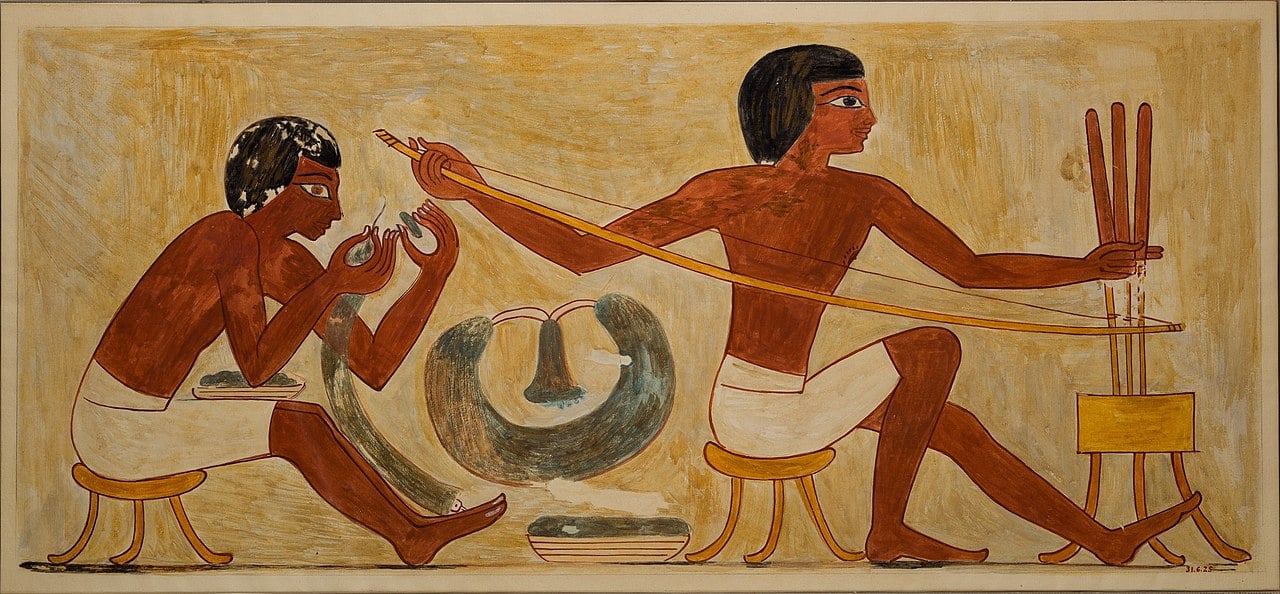
Researchers believe the leather is the remains of a bowstring. In a bow drill, a string wraps around a shaft and is moved back and forth with a bow. The motion spins the drill rapidly, allowing for faster and more controlled work than twisting a tool by hand.
Tool central to early craftsmanship
Dr. Martin Odler, a visiting fellow at Newcastle University’s School of History, Classics and Archaeology and lead author of the study, said drills were essential to daily life in early Egypt.
Craftspeople used them to pierce wood, stone, and beads. These tasks supported furniture making, jewellery production, and other skilled trades. The findings suggest Egyptian craftspeople mastered reliable rotary drilling more than 2,000 years earlier than many previously known examples.
Later evidence confirms a long tradition
Bow drills are well documented in later periods of Egyptian history. Surviving tools and tomb paintings from the New Kingdom, dating to the second millennium BC, show artisans drilling beads and woodwork.
Many of those scenes come from tombs in the area of modern-day Luxor. Until now, physical examples of drills from much earlier periods had not been firmly identified.
Metal recipe hints at wider connections
Chemical testing added further detail. Using portable X-ray fluorescence, researchers found the drill was made from an unusual copper alloy containing arsenic and nickel, along with notable amounts of lead and silver.
Co-author Jiří Kmošek said the alloy would have produced a harder and visually distinctive metal. The presence of silver and lead may also suggest access to specialized materials or shared technical knowledge linking Egypt with the eastern Mediterranean around 3,300 BC.
Museum collections still reshape history
The research forms part of the UKRI-funded EgypToolWear project under the Horizon Europe Guarantee scheme.
Researchers say the discovery highlights the continued value of museum collections. Objects excavated long ago can still yield major insights. In this case, a small and once-overlooked tool has preserved rare evidence of early metalworking and how ancient craftspeople used it.