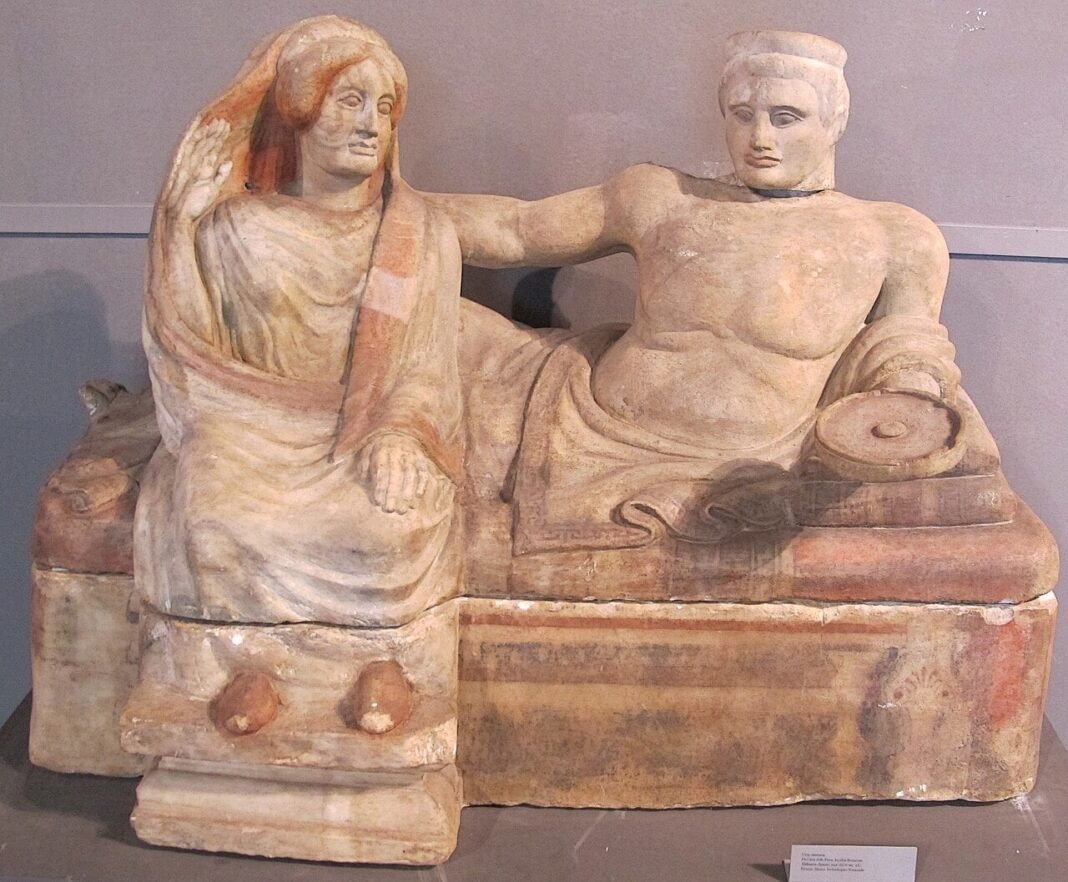
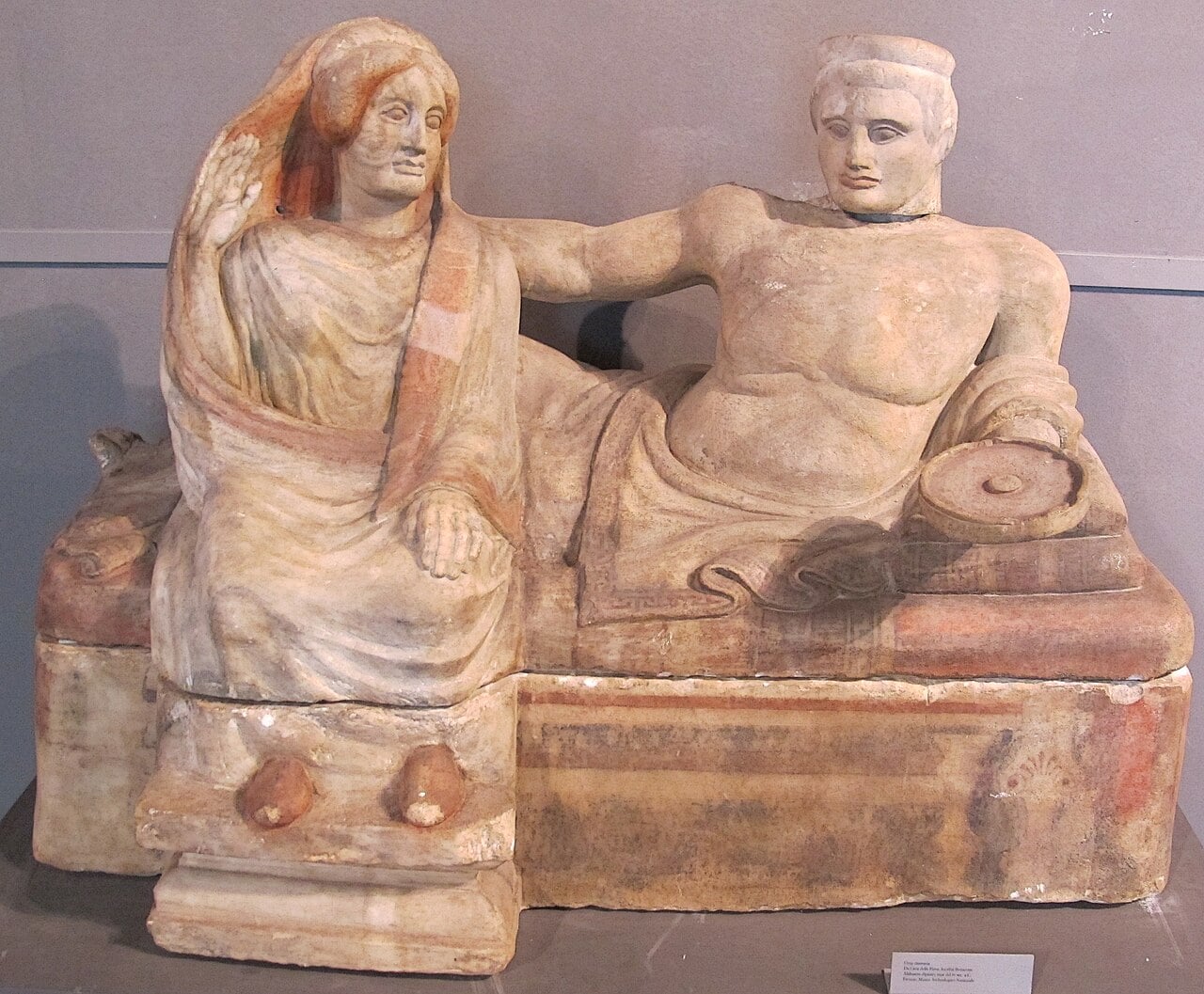
A 2,400-year-old Etruscan funerary urn showing a bride and groom in a quiet embrace has been restored to its original colors, bringing new clarity to one of Florence’s most intimate ancient artworks.
The alabaster urn, preserved at the National Archaeological Museum in Florence, is being presented to the public more than half a century after it was damaged in the devastating 1966 Arno River flood. The restored Etruscan funerary urn reveals pigments that had been hidden for decades and restores the emotional strength of the figures carved on its lid.
The urn was carved between 425 and 380 B.C. from white alabaster streaked with gray veins. Archaeologists discovered it in 1864 at Bottarone near Città della Pieve. It entered the Florentine museum’s collection in 1887 after passing through private collections.
The lid depicts a husband and wife reclining together, a rare subject in funerary sculpture from Chiusi, where artists usually showed the deceased with a winged female spirit guiding the soul to the afterlife. In this case, the woman is clearly the wife, identified by a gesture of unveiling.
Flood damage and early conservation efforts
The Arno flood of November 1966 sent more than two meters of water and mud into the museum, damaging storage rooms, archives, and restoration labs. The urn survived but suffered surface discoloration and structural issues.
A first restoration between 1969 and 1970 focused mainly on removing mud and stabilizing weakened areas, including the male figure’s head. Over time, the stone turned gray, and details faded.
A 2,400-year-old Etruscan funerary urn showing a bride and groom has been restored in Florence, revealing its original colors decades after damage from the 1966 Arno flood. pic.twitter.com/6NRzYoDCyK
— Tom Marvolo Riddle (@tom_riddle2025) February 27, 2026
A new conservation campaign began in 2022 after the project received funding through an agreement between Italy and Switzerland, with support from the Swiss Federal Office of Culture.
Conservator Daniela Manna carried out the restoration under the supervision of museum specialists Barbara Arbeid, Giulia Basilissi, and Mario Iozzo.
Study reveals original colors of the Etruscan funerary urn
Researchers used advanced imaging techniques to study the surface. The analysis identified traces of Egyptian blue along with ochre and cinnabar. Basilissi said the findings allowed specialists to map the original color scheme and better understand how the urn once appeared.
The results confirm that Etruscan sculpture was richly painted, challenging the long-held idea that ancient stone works were meant to be plain white.
Museum director Daniele Federico Maras described the project as a strong example of cooperation between experts, public institutions, and international partners. He said the restoration shows how objects damaged by disaster can gain new life through careful study and shared resources.
The restored Etruscan funerary urn is being shown during the tourism and cultural heritage fair at the Palazzo dei Congressi from Feb. 27 to March 1, with free admission. After the event, it will return to the Etruscan galleries of the National Archaeological Museum in Florence.