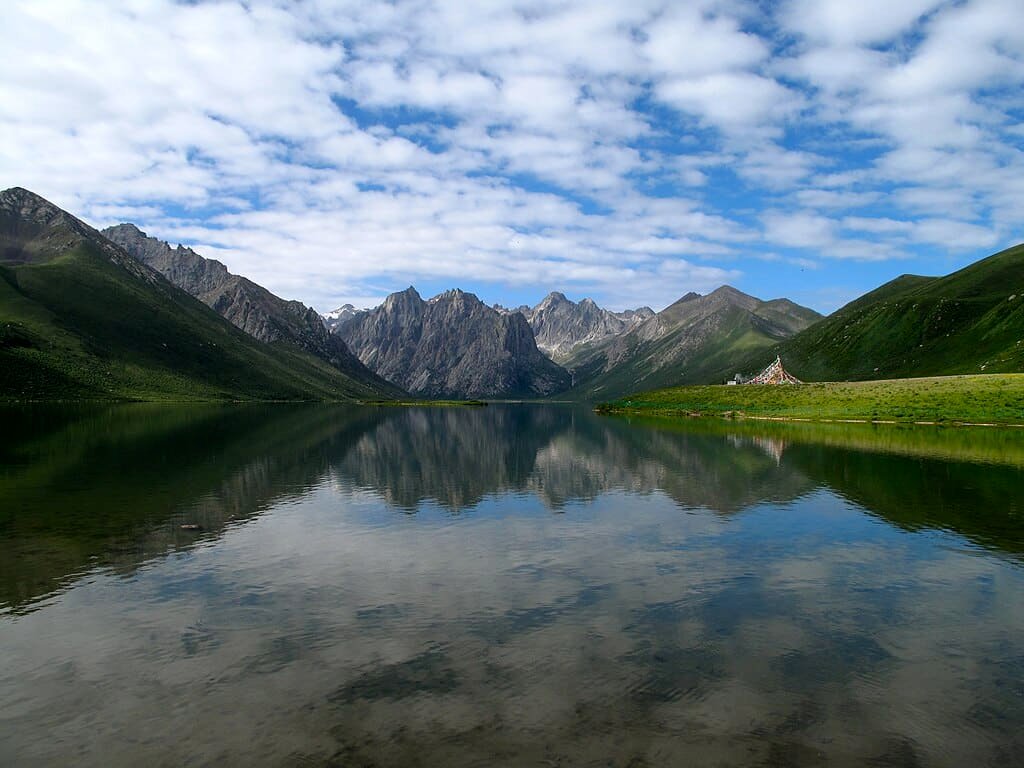

Chinese scientists have identified fossil remains of freshwater fish dating back about 15 million years in northwest China, offering new evidence that the interior of the Qinghai-Tibet Plateau once supported thriving aquatic ecosystems.
The fossils were discovered in the Lunpola Basin, one of the highest sedimentary basins in the world. Today, the region sits at an average elevation of roughly 4,600 meters and is marked by thin air, cold temperatures, and limited surface water. Researchers say the newly identified fish fossils point to a very different environment during the Miocene epoch.
Fossils recovered from a high-altitude basin
The study was carried out by scientists from the Institute of Vertebrate Paleontology and Paleoanthropology and the Institute of Hydrobiology, both under the Chinese Academy of Sciences.
Researchers analyzed fossil specimens collected from two nearby sections within the Lunpola Basin. Material from the Chebuli section dates to about 15 million years ago, while specimens from the Lunbori section range between 16 and 18 million years. The Chebuli fossils form the core focus of the study due to their clearer stratigraphic age.
Anatomical features point to new fish types
Detailed morphological examination showed that the fossils belong to the Cyprinidae family, which includes modern carps and minnows. The Chebuli material consists of part of a skull and an incomplete skeletal fragment, while the Lunbori specimen is an incomplete spinous fin ray marked by serrations extending to its base.
Chinese scientists have discovered new cyprinid fish fossils from the early and middle Miocene of the Lunpola Basin in the Qinghai-Tibet Plateau. These findings indicate notably high fish diversity on the plateau between 18 and 15 million years ago. pic.twitter.com/f9NI6Pju4Z
— Tom Marvolo Riddle (@tom_riddle2025) February 26, 2026
Despite being fragmentary, the remains preserve key anatomical features. Comparisons with both living species and known fossil cyprinids revealed clear structural differences. Researchers concluded that the fossils likely represent two previously unknown cyprinid types, distinct from other freshwater fish documented from the Tibetan Plateau during the Cenozoic era.
Evidence of stable freshwater environments
Scientists say the presence of cyprinid fish suggests long-lasting freshwater systems once existed in the region. Such fish require relatively stable rivers or lakes to survive and reproduce. Their presence indicates that the plateau’s interior supported sustained aquatic habitats during the Miocene.
The findings challenge earlier assumptions that high-altitude regions hosted only limited freshwater life in the distant past. Instead, researchers say the plateau likely experienced environmental conditions capable of supporting complex food webs and diverse fish populations.
Climate clues from ancient fish remains
The fossils also provide insight into the plateau’s ancient climate. According to the research team, the region likely experienced a warm-temperate paleoclimate around 15 million years ago. Such conditions would have supported freshwater ecosystems well before tectonic uplift and climate cooling reshaped the landscape.
Links to East Asia’s modern fish diversity
East Asia today is one of the world’s richest regions for freshwater fish diversity. According to Wu Feixiang, the corresponding author of the study published in Acta Geologica Sinica, the evolution of modern East Asian fish fauna is closely linked to major geological and climatic changes.
Researchers point to the Qinghai-Tibet Plateau as a central driver of these processes. The uplift of the plateau reshaped river systems, influenced rainfall patterns, and strengthened the Asian monsoon, creating conditions that promoted fish diversification across large parts of southern China.
Fossils help trace long-term evolutionary patterns
Scientists say studying the Cenozoic fish history of the plateau is essential for understanding how East Asia’s freshwater biodiversity formed. The Lunpola fossils help fill gaps in this evolutionary record by showing how fish populations responded to changing landscapes and climates over millions of years.
Together, the findings offer a new perspective on how geological forces, climate change, and biological evolution combined to shape one of the world’s most diverse freshwater regions—beginning with fish that swam across a much gentler plateau 15 million years ago.