

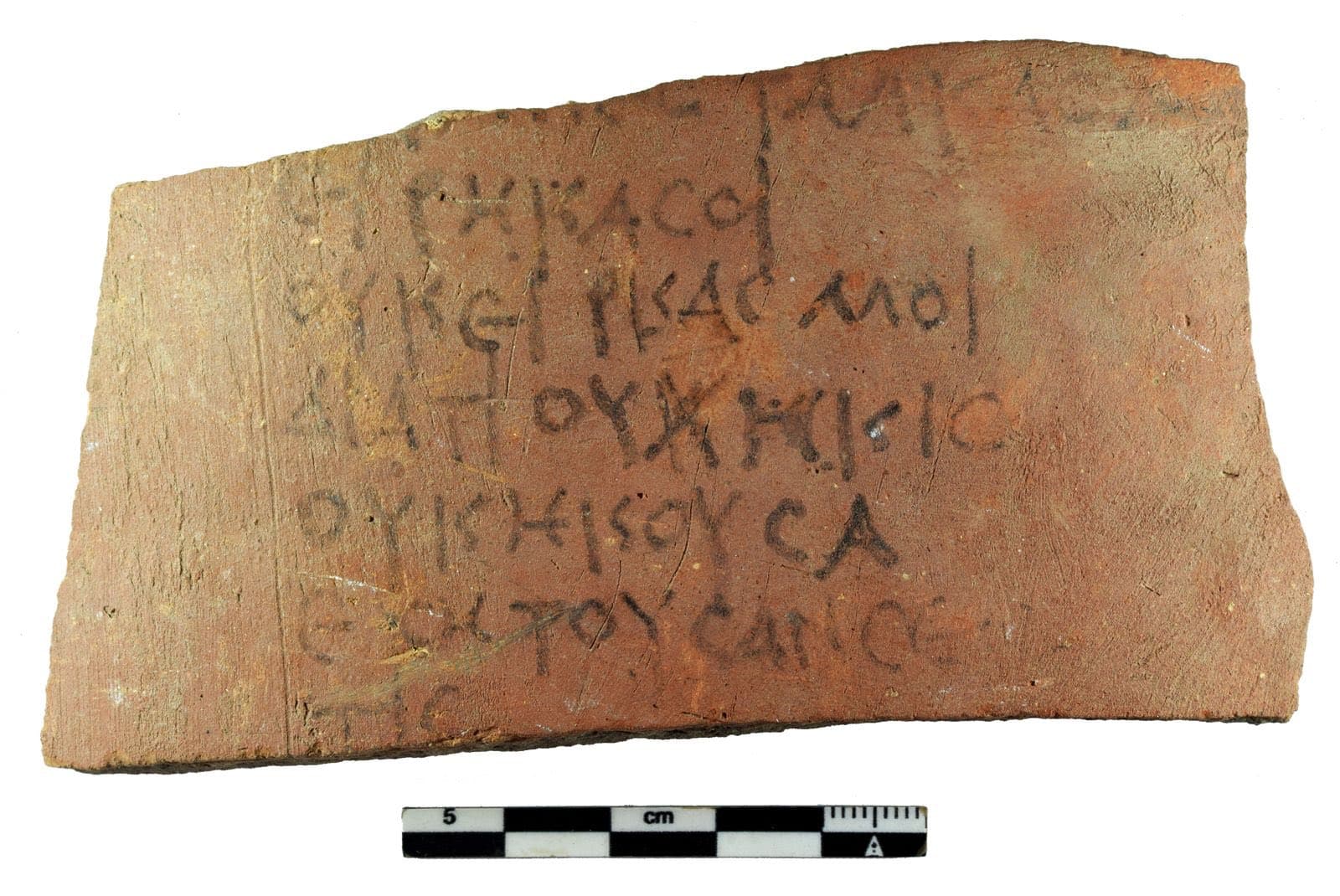
Archaeologists working in southern Egypt have uncovered 13,000 inscribed pottery fragments, known as ostraca, at the ancient city of Athribis in Sohag Governorate. The discovery adds to one of the largest collections of written artifacts ever found at a single archaeological site in Egypt.
The finds were made during the current excavation season by a joint Egyptian-German archaeological mission led by Egypt’s Supreme Council of Antiquities and the University of Tübingen in Germany.
Ostraca are pieces of broken pottery used in antiquity as a convenient and inexpensive writing surface. People often wrote short texts on them, including letters, accounts, school exercises, and administrative notes.
Largest collection of ostraca at a single site
Officials say the discovery is an important contribution to the study of ancient Egyptian society. Sherif Fathy, Egypt’s Minister of Tourism and Antiquities, said the newly discovered texts provide valuable information about the country’s social and economic systems across different historical periods.
Dr. Hisham El-Leithy, Secretary-General of the Supreme Council of Antiquities, said excavations at Athribis have now produced about 43,000 ostraca since work began in 2005. This number represents the largest collection of ostraca ever found at a single archaeological site.
The discoveries at Athribis now exceed those uncovered at Deir el-Medina, the well-known workers’ village in western Luxor that long held the record for such finds.
Recent excavations reveal thousands of texts
Mohamed Abdel-Badie, head of the Egyptian Antiquities Sector and leader of the Egyptian side of the mission, said most of the discoveries were made in recent years.
According to Abdel-Badie, more than 42,000 ostraca have been uncovered at the site since 2018 alone. The large number reflects the intensive excavation work carried out across the archaeological area.
Researchers have also identified over 130 ostraca connected to zodiac and astrological topics. Many of these texts are written in Demotic and Hieratic scripts, which were commonly used in everyday writing in ancient Egypt.
Texts written in many languages including Greek
Dr. Christian Leitz, head of the German mission, said the ostraca include texts written in several languages and scripts spanning more than a thousand years.
The oldest fragments are tax receipts written in Demotic script, dating to the 3rd century BC. The most recent examples are pottery labels written in Arabic, dating from the 9th to the 11th centuries AD.
Researchers estimate that 60% to 75% of the ostraca are written in Demotic, while 15% to 30% are written in Greek. Smaller numbers contain Hieratic, Hieroglyphic, Coptic, and Arabic texts, along with some fragments that include drawings or geometric designs.
Records of daily life and religious activity
Dr. Marcus Müller, director of the Athribis archaeological site, said many of the texts contain documentary records such as accounts, lists, tax receipts, delivery orders, and writing exercises used by students.
Other inscriptions relate to religious life. These include hymns, prayers, dedication texts, and records connected to the inspection of ritual sacrifices carried out by temple priests.
Since the 2018–2019 excavation season, a multidisciplinary research group known as “Ostraca d’Athribis,” organized by Professor Sandra Lippert in Paris, has been responsible for studying the material. The team includes specialists in ancient languages, scripts, and pottery.
Ancient city of religious importance
The Athribis archaeological area lies in Nag‘ Sheikh Hamad, about 7 kilometers (4 miles) west of Sohag in Upper Egypt. In antiquity, the city belonged to the ninth nome of Upper Egypt, whose capital was Akhmim.
Athribis was also an important religious center dedicated to the lioness goddess Repit, who was regarded as the Eye of the Sun God. She formed a local divine triad with the god Min of Akhmim and the child god Kolanthes.
Researchers say the thousands of newly discovered ostraca will help scholars better understand the history, culture, and religious practices of the ancient city.


