

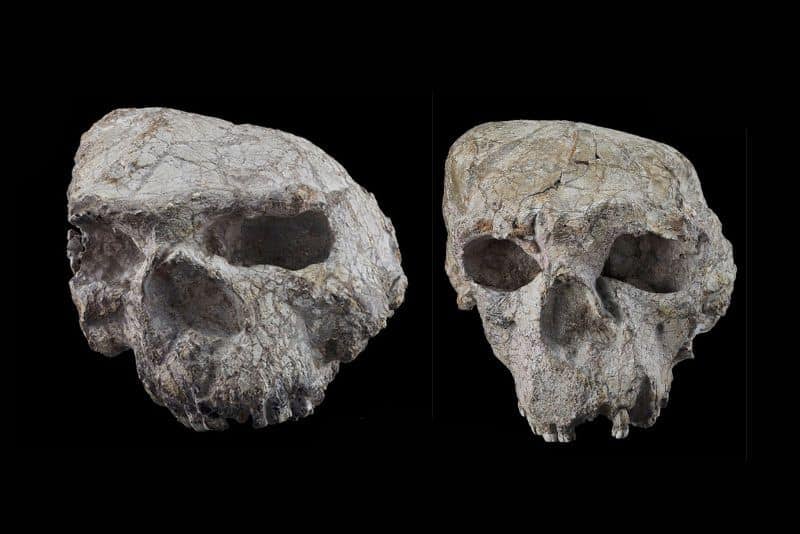
Three ancient skulls found in central China are far older than scientists once believed, pushing back the timeline of Homo erectus in China and altering long-held views about early human movement across Asia, a new study reports.
The fossils belong to Homo erectus, an early human relative. Researchers now say the skulls are about 1.77 million years old. That is roughly 600,000 years older than previous estimates and makes them the oldest known hominin fossils in East Asia.
The skulls were discovered at the Yunxian site in Hubei province over several decades, between 1989 and 2022. The findings were published Wednesday in Science Advances.
A surprising shift in the timeline
The revised age came as a surprise to the research team. Christopher Bae, an anthropologist at the University of Hawaii at Manoa and a co-author of the study, said the results were far older than expected.
He said the findings may require scientists to reconsider when Homo erectus first appeared. Until now, the species was thought to have emerged in Africa around 2 million years ago.
For decades, the strongest evidence for early humans outside Africa came from fossils dated between 1.78 million and 1.85 million years old at the Dmanisi site in Georgia. Those remains have long been considered the earliest proof of humans in Asia.
The Yunxian skulls are close in age to the Dmanisi fossils, suggesting Homo erectus spread across Asia much faster than scientists once believed.
Stone tools complicate the picture
The new findings also add context to earlier discoveries in China. Stone tools found at two sites have been dated to about 2.1 million and 2.43 million years ago. These tools are significantly older than the Yunxian skulls and predate the accepted origin of Homo erectus.
Three Homo erectus skulls found in China are now dated to about 1.77 million years old, making them the oldest known hominin fossils in East Asia, researchers report.
The findings suggest early humans spread across Asia far faster than once believed. pic.twitter.com/WNYAbLC9oE
— Tom Marvolo Riddle (@tom_riddle2025) February 19, 2026
As a result, a gap of about 600,000 years remains between the earliest stone tools and the oldest confirmed human fossils in China. That gap raises questions about which early human relatives made the tools.
A long-debated site revisited
The age of the Yunxian fossils has been debated for years. Early estimates placed them at around 1 million years old, based largely on the age of animal remains found nearby. A later study suggested an age of about 1.1 million years using electron spin resonance and uranium-series dating.
To revisit the debate, researchers applied a newer approach known as cosmogenic nuclide burial dating.
How scientists dated the fossils
The method focuses on quartz found in the sediment layers that held the skulls. Quartz absorbs cosmic radiation when exposed at Earth’s surface. Once buried, that exposure stops.
Scientists measured the decay of two rare isotopes, Aluminum-26 and Beryllium-10. By comparing their decay rates, researchers calculated how long the sediment had been buried. The results placed the Yunxian skulls at about 1.77 million years old.
Signs of early diversity outside Africa
The skulls also reveal notable biological differences. Despite being similar in age to the Dmanisi fossils, the Yunxian skulls are larger and show evidence of bigger brains.
Karen Baab, a professor of anatomy at Midwestern University who was not involved in the study, said the contrast highlights early diversity among hominins living outside Africa.
Experts urge caution
Not all researchers are convinced. Chris Stringer, a paleoanthropologist at the Natural History Museum, said the new age would be remarkable if confirmed, but warned it may conflict with other fossil evidence.
Stringer has previously suggested the Yunxian fossils could belong to a population that later gave rise to the Denisovans, thought to have emerged around 1.2 million years ago. If the new date holds, he said, it may also affect how scientists understand the ancestry of Homo sapiens.
For now, researchers agree on one point. Further dating work at Yunxian will be essential before the new timeline of Homo erectus in China can be fully accepted.


